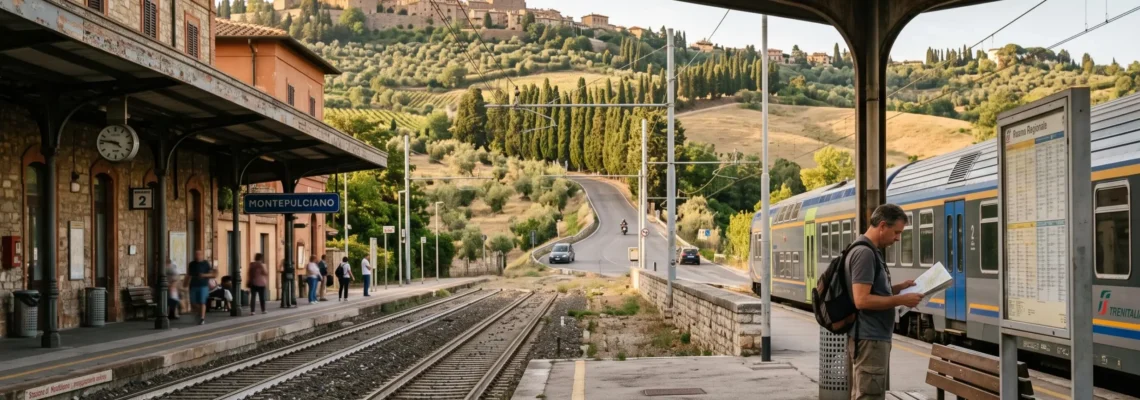
There is no single best way to get around Tuscany: the right choice depends on three variables — the sub-zone you are visiting (urban hub vs rural countryside), the length of your stay, and your starting point — plus your tolerance for driving. A short city break in Florence needs only trains and buses; a tour of Val d’Orcia or Chianti hill towns requires a rental car or an organized excursion. The grid below matches the most common travel scenarios to the mode — or combination of modes — that fits them, with the mixed itinerary (train between cities, car or excursion for the countryside) often the optimal answer.
The short answer: it depends on your scenario, not on a single ‘best’ mode
Tuscany is not served evenly by any one transport mode, which is why the question « what is the best way to get around Tuscany? » has no universal answer. Three variables change the response. First, the sub-zone: regional trains link Florence with Lucca, Pisa and Siena, making the main urban hubs easy to combine by rail, while villages in Chianti aren’t reachable by train and some countryside destinations are served by bus only once or twice per day. Second, the duration of your stay: a two-night city trip cannot absorb the cost and logistics of a rental car, while a week-long rural itinerary cannot rely on sparse rural buses. Third, your starting point: basing yourself in Florence gives you the densest rail connections, while a rural base makes a car almost unavoidable.
A fourth, quieter variable also matters: your tolerance for driving. Planning wine tastings in Chianti or fatigue after a long flight should push you toward an organized excursion rather than a self-driven rural route.
The decision grid below — built by this article as an analytical synthesis from the documented facts on rail links, rural coverage and restricted zones covered in the following sections — turns those variables into a direct recommendation per scenario:
| Scenario | Recommended mode | Mode to avoid |
|---|---|---|
| Short urban stay (Florence, Pisa, Siena, Lucca) | Regional train between hubs + local buses and walking | Rental car (ZTL fines, scarce parking) |
| Mixed trip: cities + countryside day trips | Train between cities + rental car or organized excursion for rural days | Car for the whole stay (urban ZTL exposure) |
| Itinerant rural route (Val d’Orcia, Chianti hill towns) | Rental car, driven between rural bases | Train (does not reach hilltop villages) and rural buses (limited frequency) |
| No car available (no licence, wine tasting planned, short stay) | Train between hubs + organized multi-day excursions for the countryside | Relying on rural buses on Sundays and holidays |
Each cell of this grid is developed — with its documented basis and its limits — in the sections that follow.
Why Tuscany isn’t one territory: urban hubs vs rural zones
Tuscany splits into two transport worlds, and the same question calls for opposite answers depending on which one you are in. Florence, Pisa, Siena and Lucca work as urban hubs well connected by regional rail, while Val d’Orcia, Chianti and the southern hills depend on a car or an excursion — which is why a single « best mode » claim fails factually. This segmentation covers the rail-connected hubs and the rural interior; other sub-regions, such as the coastal strip, follow the same underlying logic of hubs-versus-road-dependent territory described below, so the same diagnostic applies.
Florence is the strongest rail base: trains of the same regional type serve the Florence–Siena route, and the double-deck Vivalto regional trains used on the Florence–Lucca line (1h19–1h45, 8.40 € one-way) also run on some Florence–Pisa services. Lucca, Pisa and Siena each function as bases where you can stay without a car and reach the other hubs by train.
Rural sub-zones tell the opposite story. There is no adequate rail service across
Val d’Orcia
or the Chianti hill towns: stations, where they exist, sit far from the perched villages travelers actually want to visit. In these areas,
Autolinee Toscane
‘s rural bus network covering Chianti and Mugello — run by
RATP Dev
, guaranteeing service in both small towns and larger cities like Florence and Arezzo — is the operative public-transport layer, not the train. Bus coverage, however, does not equal convenience: frequencies can drop to one or two services per day on some countryside routes.
| Sub-zone | Rail / bus coverage | Dominant transport logic | Mode that fits |
|---|---|---|---|
| Florence, Pisa, Siena, Lucca | Frequent regional rail between hubs; urban buses and walking | Hub-to-hub rail | Train + local bus/foot |
| Chianti, Mugello, Val d’Orcia | No suitable rail to hilltop villages; rural buses, sometimes once or twice daily | Road-based access | Car or organized excursion |
| Other non-hub sub-regions (e.g. the coastal strip) | Rail coverage limited to hub lines; local roads carry most access | Road-based access, per the hub-vs-rural logic above | Car or organized excursion, depending on how far you go from the rail line |
One further rural reality worth anticipating as a practical caution: Tuscan country roads tend to be narrow and winding, so real journey times can run longer than raw distances suggest — budget extra time for countryside legs, even behind the wheel.
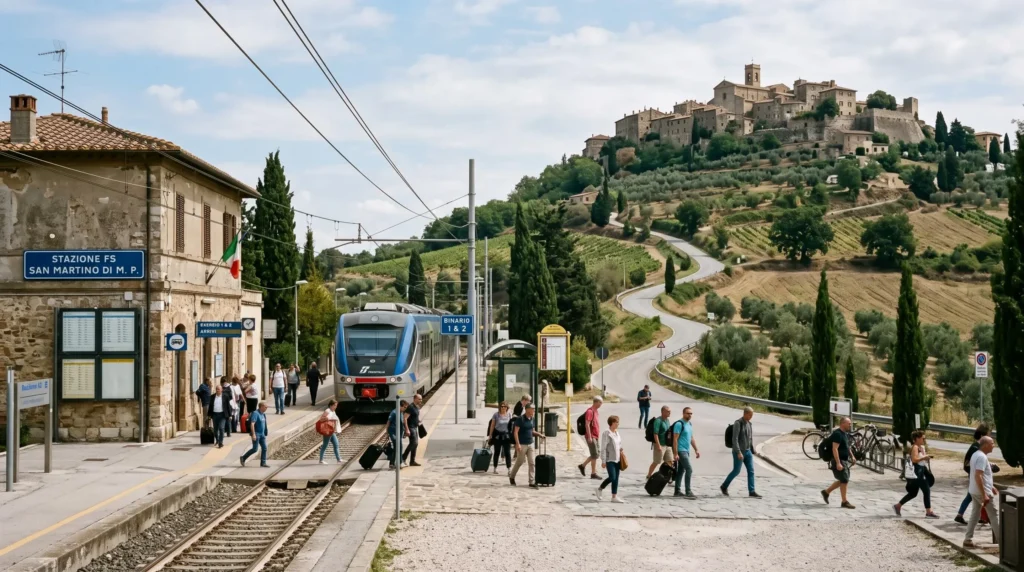
Car-free Tuscany: multi-day organized tours as the third option
Multi-day organized excursions are a credible third option in the usual car-vs-train debate — particularly relevant for short stays, travelers without a licence, and anyone who does not want to drive after a wine tasting — even though they impose an explicit trade-off: a fixed rhythm and a fixed perimeter. The option is often absent from the standard debate because it sits between the two usual camps: it removes the driving burden of a rental car without depending on sparse rural buses.
Concrete formats make this option verifiable rather than theoretical. Tootbus offers « Tuscany day trip » excursions of 2, 3 or 5 days combining hop-on hop-off bus with free walking tours, multilingual audio guides and a guidance app, with four experiences priced from €34.30. That description of formats and displayed pricing comes from the operator itself; its availability and perimeter should be re-checked before booking, and the offer should be read as an example of the format, not as independent evidence of quality. Beyond any single operator, multi-day tours departing from the major Tuscan cities do exist as a category — but treat the availability of any specific departure as something to verify before you build your itinerary around it.
Typical use cases where this third option wins:
- Short stays (2–4 days) where renting a car for one or two countryside days is not worth the logistics
- Travelers without a driving licence
- Itineraries including wine tastings, where driving yourself is off the table
- Trips without a fixed rural base, where a tour covers the countryside from a city hotel
The limits are equally concrete: you accept the operator’s rhythm and route, you cannot linger where you please, and the per-person price must be compared with the full perimeter of a self-organized day — rental, fuel and parking on one side, train or bus tickets on the other — rather than with the car alone. That comparison is developed in the costs section below.
When a rental car is essential — and when it works against you (ZTL, parking, rural gaps)
A rental car is essential for city-to-hilltop-village rural itineraries, but it becomes a liability in historic centers and after wine tastings — while the train fails in the countryside and rural buses lose reliability on weekends. Choosing the best way to get around Tuscany is as much about avoiding these traps as about picking a mode. Each mode has a concrete switching rule: the condition under which it flips from optimal to handicap.
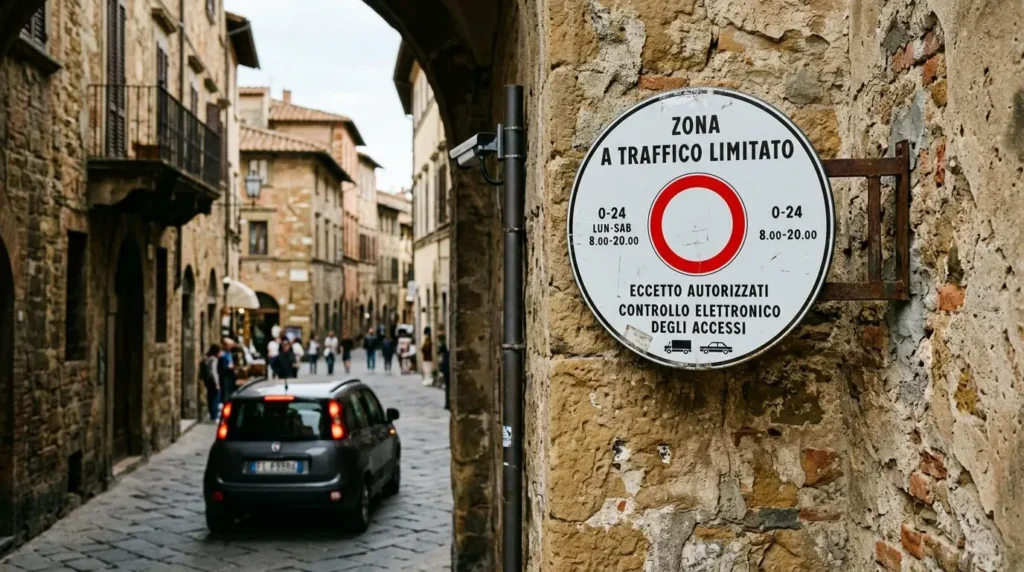
Car + historic center = ZTL fine. Florence’s historic centre ZTL rules and hours define the entire historic centre as a Limited Traffic Zone divided into five sectors (A, B, O, F, G), monitored by automatic electronic gates that read license plates: in sectors A, B and O the ZTL is active year-round on weekdays from 7:30 to 20:00 and Saturdays from 7:30 to 16:00, with an additional summer night ZTL extending to sectors F and G on Thursday–Saturday nights from the first Thursday of April to the first Sunday of October. Driving through without authorization triggers an automatic fine — the cost of getting this wrong is a fine per pass, not a warning. Florence and Siena are the cities where this trap bites hardest, and limited parking around the centers compounds it. Rule: leave the car at your rural base or a park-and-ride and enter cities by train or bus.
Train + hilltop village = impossible. The rail network serves the hubs, not the perched villages of Val d’Orcia or Chianti, so a train-only plan structurally excludes the landscapes most people picture when they think of Tuscany.
Rural bus + weekend or holiday = unreliable. Rural frequencies are limited and seasonal, and the cuts are documented, not anecdotal: rural bus lines around Arezzo were suspended on Easter Sunday in the Autolinee Toscane schedule change for the Easter 2026 period in that basin, with school-holiday weekdays on a reduced timetable. This is one documented, dated example in one Tuscan basin, not a region-wide rule — but it illustrates the trap: a bus-dependent countryside itinerary planned around a Sunday or public holiday can simply not run. Always check the official seasonal timetable for your dates before building a plan around rural buses.
- Car is indispensable: Val d’Orcia, Chianti hill towns, multi-village rural days, luggage-heavy rural touring
- Car works against you: entering Florence or Siena centers (ZTL fines), city-center parking, any day built around wine tastings
- Train works: Florence–Pisa–Lucca–Siena hub-to-hub travel; fails beyond them in the countryside
- Rural bus works: specific documented corridors on weekdays in season; unreliable on Sundays, holidays and off-season
Costs and putting it together: what each option costs and how to choose your mix
The arbitration becomes defensible once each mode carries its real, perimeted cost — and once the framework is applied to your own scenario rather than argued in the abstract. If you want to transpose this diagnostic to other destinations, the same logic underpins this guide on how to choose transportation for any trip. The table below compares the indicative costs of each option with what the price includes and excludes; all figures are dated and attributed to their source.
| Mode | Indicative cost | Included / excluded |
|---|---|---|
| Regional train | Official Trenitalia regional fares between Tuscan cities: €3.70 Pisa–Lucca, €6.00 Lucca–Pistoia, €4.80 Pistoia–Florence (single journey, per Trenitalia’s Tuscany Line page); Florence–Lucca €8.40 one-way per Seat61 | Includes city-to-city travel only; excludes rural areas, local buses and urban transfers |
| Organized excursion (Tootbus) | From €34.30 per person for Tootbus’s own displayed pricing on its 2, 3 or 5-day « Tuscany day trip » formats (operator-published rate, to be re-checked at booking) | Includes hop-on hop-off bus, walking tours, audio guides per the operator’s description; excludes accommodation, meals and full route flexibility |
| Rental car | Daily rental rate + fuel + parking (check live rates with rental companies for your dates; parking in historic centers is limited and priced separately) | Includes rural access and full flexibility; excludes ZTL exposure risk in city centers and the cost of your time on narrow rural roads |
| Rural / urban bus | Autolinee Toscane ticket fares per the operator’s current tariffs; lower per-trip cost, but availability varies by season and day of week | Includes fixed-corridor travel; excludes reliability on Sundays, holidays and off-season in rural basins |
To apply the framework to your own trip, work through four steps in order:
- Identify your sub-zone split: which days are urban-hub days, which are countryside days?
- Check your duration: a stay too short to amortize a rental pushes the countryside days toward an excursion.
- Fix your starting point: a Florence base maximizes rail options; a rural base forces a car.
- Test your driving tolerance: wine tastings, fatigue or no licence remove the self-drive option entirely.
The resulting typical trajectories, per scenario:
- Short urban stay: train and bus only — zero rental, zero ZTL risk.
- Mixed city + countryside: train between hubs, then a rental car picked up outside the city or an organized excursion for the rural days — often the optimal mix, because it captures rail speed where rail wins and road access where roads win. For building the full route this way, this walkthrough on planning efficient multimodal itineraries applies the same hub-to-hub logic at trip scale.
- Itinerant rural: rental car throughout, based outside historic centers.
- No car at all: train between hubs plus multi-day organized excursions for the countryside.
Finally, let the season adjust the plan: off-season and weekend travel reduces rural bus reliability, which strengthens the case for either a car or an organized excursion on countryside days, while peak season adds parking pressure around the hubs.
There is no best way to get around Tuscany in the abstract — only the best way for your sub-zone, your duration, your starting point and your tolerance for driving. Diagnose those four variables, avoid the three switching traps (car in a ZTL, train to a hilltop village, rural bus on a Sunday), and the mixed itinerary — train between cities, car or excursion for the countryside — is most often where the optimal answer lands. Once on the ground, exploring cities like a local on public transport is often the fastest way to experience the hubs the way Tuscans do.