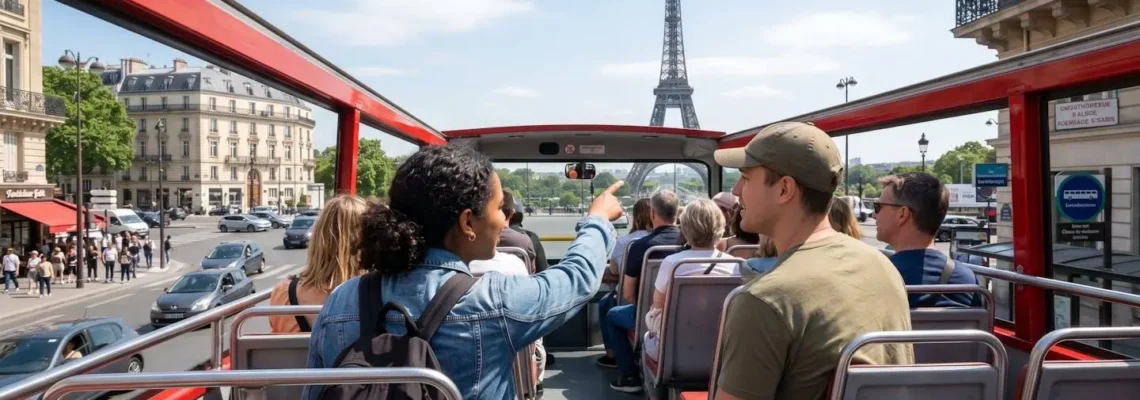
Paris welcomed a staggering 48.9 million overnight stays during the 2025 summer season, with the latest data from INSEE Île-de-France confirming that US travelers remain the largest international visitor group. This surge creates a practical problem: navigating packed Metro lines while maximizing limited vacation time. Hop-on hop-off bus tours promise a solution, but not all operate the same way. Tootbus, Big Bus Paris, and Open Tour each position themselves as the ideal choice, yet their route strategies, app technologies, and actual bus frequencies differ significantly. The question isn’t whether these tours work—it’s which one matches your specific Paris trip.
What matters most before you book:
- GPS-tracking operators lead for app-focused travelers with real-time bus locations and AI guide integration
- Big Bus delivers premium brand recognition with established international service standards
- Actual bus frequency affects your day more than total stop count—20-minute waits beat 30 stops with 45-minute gaps
- Book online for typical savings versus walk-up on-board purchases
What Actually Makes a Paris Bus Tour Worth Your Time
The hop-on hop-off concept sells flexibility, but that promise collapses when buses arrive every 40 minutes instead of the claimed 15. Based on 2025-2026 traveler feedback patterns across major review platforms, the most common complaint isn’t route coverage or audio quality—it’s waiting time that destroys itineraries. A tour advertising 25 stops sounds comprehensive until you realize buses complete the full loop in 2.5 hours, creating gaps that force you to choose between staying on board or risking a 30-minute wait at your next landmark.
Among the operators addressing these frequency and technology challenges, Tootbus has positioned itself as a mobile-first solution with real-time GPS tracking integrated across its fleet. This shift from traditional printed-schedule operations to app-driven transparency represents the current evolution in hop-on hop-off services, where travelers can verify actual bus positions rather than relying on estimated intervals.
Real-world bus frequency during your travel window, mobile app GPS accuracy for tracking, route stop placement near Metro stations for extended exploration, and pass activation system transparency (calendar day versus 24-hour validity) matter more than marketed stop counts or generic « multilingual audio » claims.
Here’s the thing: Paris tourism infrastructure already strains under the sustained post-pandemic visitor recovery the city has experienced since 2024. Public transport costs rose 2.3% in January 2026, according to official Service-Public.fr tariff updates, pushing a monthly Navigo pass to €90.80. For travelers spending three days in Paris, that monthly pass makes no sense. The alternative—individual Metro tickets at current rates—adds up fast across 15-20 landmark visits. This gap creates the market for hop-on hop-off services, but only if the service actually delivers on frequency and route efficiency promises.
What travelers consistently report is that app quality separates functional tours from frustrating ones. The ability to see your next bus arriving in real time, receive accurate wait estimates, and access supplementary content (walking tour audio, AI Q&A) transforms the experience from passive transport to active exploration tool. Tours still relying on printed maps and generic « every 20 minutes » promises without GPS verification belong to a previous decade of tourism technology.
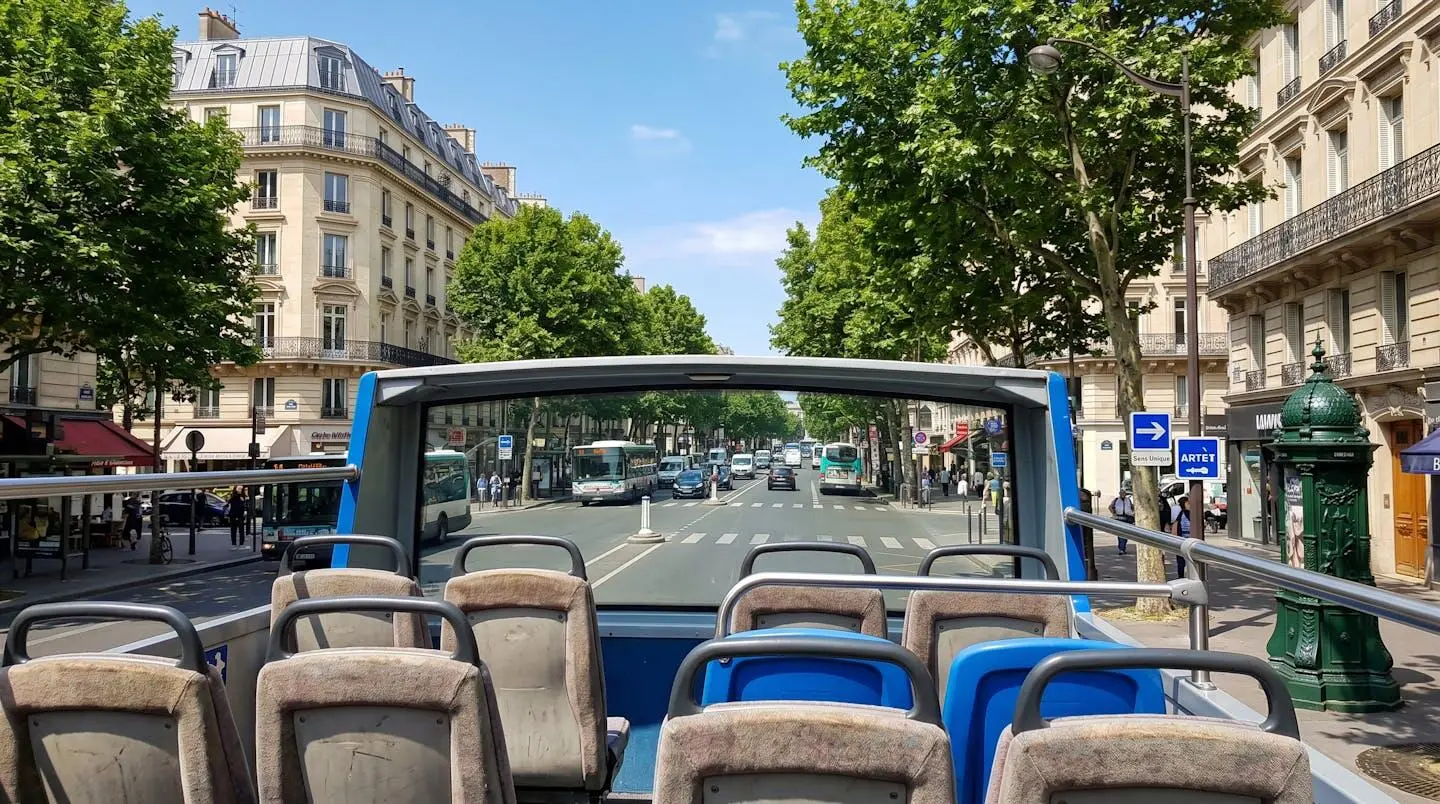
The Paris Hop-On Hop-Off Landscape: Your Complete Comparison
Four distinct approaches compete for your Paris sightseeing budget. Tootbus positions itself as the tech-forward option with AI integration and flexible partnerships. Big Bus Paris leverages international brand recognition and premium positioning. Open Tour emphasizes deep Paris-specific expertise as a local heritage operator. The DIY alternative—combining Metro passes with self-guided walking tours—appeals to budget-conscious travelers comfortable navigating independently.
Comparison data collected and updated as of January 2026.
| Option | Route Coverage | Pass Validity | App Features | Audio Quality | Partnerships | Real Frequency |
|---|---|---|---|---|---|---|
| Tootbus | All major landmarks, strategic Metro connections | 1, 2, or 3 calendar days from first scan | GPS tracking, Tootie AI guide (50+ languages), audio walking tours | Multilingual with child-specific versions | Museums, Seine cruises, guided walking tours | 15-20 min intervals peak season |
| Big Bus Paris | Comprehensive coverage, 2 route options | 1 or 2 calendar days | Basic tracking, standard audio commentary | Multilingual standard narration | Limited third-party integration | 20-30 min intervals peak season |
| Open Tour | Paris-only specialist routes | 1, 2, or 3 calendar days | Minimal digital features | Paris-focused historical depth | Local attraction partnerships | 30-45 min intervals peak season |
| DIY Metro + Walking | Full Paris Metro network coverage | Paris Visite: 1, 2, 3, or 5 consecutive days unlimited travel | RATP app for route planning | Self-guided (no narration) | None (independent exploration) | Metro: 2-8 min depending on line |
Premium Tech-Forward: Tootbus & Big Bus
The premium segment splits between technology integration and brand legacy. Tootbus built its service around mobile-first design, offering real-time GPS bus tracking that eliminates the guessing game at stops. The Tootie AI guide responds to spoken questions in over 50 languages, functioning as an on-demand concierge beyond standard audio loops. This matters when you want to know « which café near the Louvre serves authentic croque-monsieur » or « how long does Musée d’Orsay typically take to visit »—questions pre-recorded audio can’t address.
Big Bus Paris counters with established international presence across 25+ cities, appealing to travelers who prioritize brand familiarity and consistent service standards. The company operates globally standardized procedures, meaning the Big Bus experience in Paris closely mirrors what you’d encounter in London or New York. For some travelers, that predictability outweighs technological bells and whistles. The trade-off: Big Bus mobile app features remain basic compared to Tootbus’s integrated walking tour audio and partnership booking capabilities.
Local Expertise: Open Tour’s Paris-Only Approach
Open Tour positions itself as the Paris specialist, operating exclusively in the capital rather than spreading across multiple European cities. This focus translates to audio commentary with deeper historical context and local anecdotes not found in internationally standardized scripts. The company maintains partnerships with Paris-specific attractions and restaurants, though the digital experience lags behind competitors—expect printed maps rather than sophisticated app features.
The practical challenge: Open Tour’s bus frequency during shoulder season (April-May, September-October) stretches to 40-45 minute intervals on secondary routes. That’s workable if you plan to spend 90+ minutes at each landmark, but it punishes quick photo stops or travelers trying to hit 10+ sites in a single day.
DIY Alternative: Metro Pass + Walking Tours
The Paris Visite travel pass offers 1, 2, 3, or 5 consecutive days of unlimited Metro, tram, bus, and RER access, as detailed on the official RATP site. For travelers comfortable with independent navigation, this provides maximum flexibility at lower cost. The Metro runs every 2-8 minutes during peak hours, eliminating wait time concerns entirely. Pair this with free podcast walking tours or budget apps like Rick Steves Audio Europe, and you’ve built a functional alternative to hop-on hop-off services.
The hidden cost: cognitive load. You’re managing route planning, connection transfers, landmark research, and timing coordination without guided structure. First-time Paris visitors often underestimate this complexity, discovering too late that the Louvre-to-Versailles journey requires three transfers and 90 minutes rather than the straight shot they assumed. Hop-on hop-off tours eliminate this mental overhead, which has measurable value even if it’s harder to quantify than ticket price.
Where the Real Differences Show Up
Marketing materials promise « comprehensive coverage » and « frequent departures, » but the reality emerges in three specific areas where operator capabilities diverge significantly. A 20-minute wait versus a 45-minute wait doesn’t sound dramatic on paper—until you calculate that it costs you three fewer landmarks per day, transforming a satisfying overview into a frustrating race against closing times.
Real Traveler Scenario: The Three-Day First-Timer
Consider a family arriving at Charles de Gaulle on a Friday afternoon with three full days before their Monday evening departure. They want to cover the Eiffel Tower, Louvre, Notre-Dame area, Montmartre, and Arc de Triomphe without the stress of navigating Metro transfers with luggage and two children under 10. Their initial research suggests « any hop-on hop-off bus works the same way, » but the details reveal otherwise.
With a calendar-day pass system, activating at 4:00 PM Friday means their first day expires at midnight—just eight usable hours. A smarter approach activates Saturday morning at 9:00 AM, providing three full days (Saturday-Monday) rather than 2.3 days of fractional coverage. This timing strategy alone adds six hours of touring capacity, equivalent to 3-4 additional major landmarks when factoring in bus frequency and stop proximity.
The family’s specific needs—child-friendly audio, GPS tracking to eliminate wait anxiety, and accessibility for a stroller—narrow viable options significantly. Tours advertising « multilingual audio » don’t all offer child-specific narrative versions, and operators without real-time tracking apps force the family to guess whether the next bus arrives in 10 or 40 minutes while managing restless children at exposed street stops.
Route Efficiency: Stop Count vs Actual Coverage
Tours advertising 30+ stops create an illusion of thoroughness that collapses under scrutiny. What matters isn’t total stops but landmark density per route kilometer and proximity to secondary attractions. A route with 18 strategically placed stops near Metro stations enables extended neighborhood exploration—you hop off at the Marais stop, explore for two hours using nearby Metro access, then rejoin the bus route at a different point. A route with 32 stops spaced 300 meters apart offers no such flexibility; it’s simply a slow-moving observation platform.
The data suggests that routes covering 12-15 major landmarks (Eiffel Tower, Louvre, Notre-Dame, Arc de Triomphe, Sacré-Cœur, Champs-Élysées, Musée d’Orsay, Panthéon, Latin Quarter, Marais, Opéra Garnier, Place de la Concorde, Tuileries) represent the practical maximum for meaningful three-day exploration. Tours attempting to add Versailles, Disneyland Paris, or distant suburbs dilute the core Paris experience without adding proportional value for first-time visitors working within 72-hour windows.
The App Experience: GPS Tracking and AI Guides
Mobile app quality determines whether you control the tour or the tour controls you. Real-time GPS tracking transforms your planning: instead of arriving at a stop and waiting blindly, you see « Next bus: 7 minutes » and decide whether to grab coffee or board immediately. Tootbus implemented this feature across its entire fleet, with the app displaying live bus positions on route maps and sending notifications when your selected bus approaches.
50+
Languages supported by Tootbus Tootie AI guide for on-demand traveler questions beyond standard audio loops
The Tootie AI functionality extends beyond translated audio commentary into conversational assistance. Travelers report using it for restaurant recommendations near current locations, museum wait time estimates, and photography spot suggestions—queries that pre-recorded content can’t address. The system operates offline for core features, critical given that international data plans often fail in Metro tunnels or thick-walled Parisian buildings.
Hidden Costs and True Value Calculation
Online booking typically delivers noticeable savings below walk-up on-board purchases across all major operators, with discounts varying by season and operator. The spread widens during peak summer season (June-August) when demand pricing kicks in. A two-day pass purchased online in April 2026 might cost €45, while the same ticket bought on-board in July reaches €55. Compound this across a family of four, and advance planning saves $60-80 USD.
- GPS tracking eliminates wait time uncertainty
- Tootie AI guide handles custom questions in 50+ languages
- Integrated walking tour audio extends value beyond bus
- Partnership bundles with museums and Seine cruises
- App dependency creates vulnerability if phone battery dies
- Newer brand lacks Big Bus international recognition
- Calendar day validity can disadvantage late afternoon starters
Partnership bundles require careful math. A combined Tootbus + Seine cruise ticket might advertise €65 versus €50 bus-only, positioning the cruise as just €15 extra. Compare that to standalone Seine cruise operators charging €18-22, and the bundle saves €3-7—legitimate but modest. The real value emerges if you were planning both activities anyway; the bundle becomes inefficient if it pushes you toward experiences you wouldn’t otherwise prioritize. For broader insights on maximizing comfort during extended sightseeing days, this guide on bus travel in foreign countries covers practical strategies for long touring days.
Which Bus Tour Matches Your Paris Trip
The question « which tour is best » lacks a universal answer because traveler priorities differ fundamentally. A tech-focused millennial planning Instagram content needs different tools than a family with young children prioritizing educational audio or seniors seeking comfortable seating with minimal walking. The decision tree below maps four traveler profiles to their optimal matches based on verifiable criteria rather than marketing claims.
- If mobile technology significantly enhances your travel experience:
Choose Tootbus for real-time GPS tracking, conversational AI guide, and integrated walking tour audio. The app-first design assumes you navigate with smartphone assistance and value digital integration over traditional printed materials.
- If brand recognition and premium positioning matter more than technological features:
Select Big Bus Paris for established international service standards and predictable experience across their global network. The premium positioning delivers consistent quality without requiring comfort with mobile apps.
- If deep Paris-specific historical context outweighs digital convenience:
Open Tour’s local expertise and Paris-focused audio commentary provide richer contextual depth, though you’ll trade app features and tighter frequency for that specialization.
- If you’re comfortable with independent navigation and prioritize budget efficiency:
DIY Metro + walking tours combination offers maximum flexibility and lowest cost, assuming you’re willing to invest cognitive effort in route planning and don’t require guided audio structure.
Once you’ve identified your ideal tour approach, complete your Paris planning with this comprehensive travel preparation checklist covering all essential pre-departure details from documentation to packing strategies.
Common Questions About Paris Bus Tours
Does a 1-day pass mean 24 hours or just one calendar day?
Most Paris hop-on hop-off operators use calendar day validity, meaning a pass activated at 4:00 PM expires at midnight that same day—not 24 hours later. This catches many travelers off guard. Tootbus, Big Bus, and Open Tour all operate on calendar day systems. To maximize value, activate your first-day pass in the morning rather than late afternoon. Multi-day passes (2-day, 3-day) count consecutive calendar days from activation.
Can I use my ticket across different operators or routes?
No. Tickets are operator-specific and non-transferable between companies. A Tootbus pass won’t work on Big Bus vehicles, and vice versa. However, within a single operator, your pass typically covers all their Paris routes. Tootbus offers multiple themed routes (Discovery, Must See, hop-on with Emily) all accessible with one pass, though some specialized tours may require separate tickets.
Are the buses wheelchair accessible and suitable for travelers with limited mobility?
Accessibility varies by operator and specific bus model. Most buses offer lower-deck seating accessible without stairs, but iconic upper-deck views require climbing steep steps. Tootbus and Big Bus both operate wheelchair-accessible vehicles on select routes—contact operators 24-48 hours before your visit to confirm availability and reserve accessible seating. Open Tour’s older fleet has more limited accessibility options. For travelers with mobility concerns, verify specific vehicle accessibility rather than assuming all buses accommodate wheelchairs.
What happens if I miss the last bus of the day while exploring a landmark?
You’re responsible for your own return transportation. Bus services typically end between 6:00 PM and 8:00 PM depending on season, but museums and attractions often stay open later. Check your operator’s specific last departure time from each stop—this information appears in mobile apps or printed schedules. Budget for Metro fare or taxi as backup if you’re cutting timing close. The Paris Metro runs until approximately 12:40 AM weekdays and 1:40 AM weekends, providing reliable fallback transport.
Do I need to book specific time slots or can I just show up at any stop?
Hop-on hop-off tours operate on continuous loop schedules without required reservations. Purchase your pass online or at any stop, then board any bus showing available capacity. During peak summer season (July-August), popular stops near the Eiffel Tower or Louvre may have full buses pass by—in that case, wait for the next bus (typically 15-30 minutes). No advance time slot booking is necessary or available for standard hop-on hop-off services, though some specialized themed tours may require reservations.
- Download the mobile app for your chosen operator 24 hours before arrival to test GPS functionality and familiarize yourself with the interface
- Verify current bus frequency for your specific travel dates (shoulder season vs peak summer) through recent reviews or direct operator contact
- Compare online booking prices to walk-up rates and factor in any partnership bundles relevant to your planned activities
- Plan your first-day activation timing to maximize calendar day validity—morning starts provide 8-10 usable hours versus 4-5 for afternoon activations
- Bring portable phone charging backup if selecting app-dependent options like Tootbus to avoid losing GPS tracking and AI guide access mid-day
The right Paris bus tour depends less on which operator wins abstract « best » rankings and more on which service architecture matches your specific travel style, technological comfort level, and itinerary priorities. Tech-integrated explorers gain measurable value from Tootbus GPS tracking and AI assistance, while tradition-focused travelers may find Big Bus brand familiarity or Open Tour’s Paris expertise more reassuring than digital features. What matters most is aligning the tour’s actual capabilities with your real needs rather than choosing based on marketing promises or surface-level price comparison.